When Did the Beirut Explosion Happen and What Time?
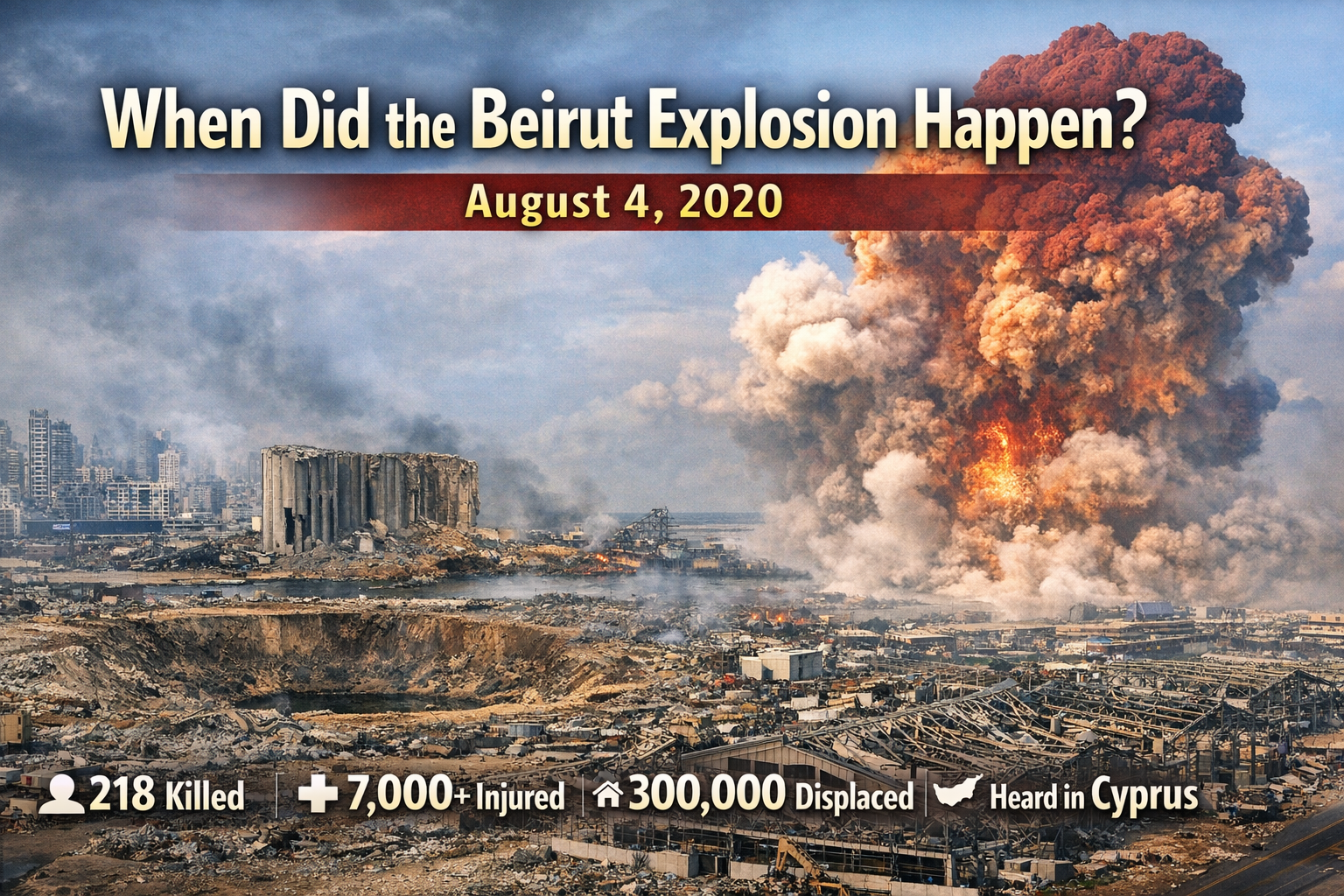
When did the Beirut explosion happen? The Beirut explosion happened on August 4, 2020 at 6:07 PM local time at the Port of Beirut. The massive blast became one of the largest non-nuclear explosions in modern history, killing 218 people and injuring more than 7,000.
What Caused the Beirut Explosion?
Authorities stored 2,750 tons of ammonium nitrate inside Warehouse 12 at the port. Officials had confiscated the material in 2013 from a cargo ship. They left it there for nearly six years without proper safety measures.
On 4 August 2020, a fire broke out inside the warehouse. Witnesses saw smoke and small explosions before the massive detonation. The fire ignited the ammonium nitrate. The chemical exploded with enormous force.
Experts estimated the blast’s power at roughly 1 to 1.2 kilotons of TNT. The explosion created a massive shockwave. It formed a huge mushroom cloud over the city. The blast carved a deep crater at the port.
Investigations pointed to negligence and poor storage conditions. Officials had received several warnings about the dangerous material. They did not remove it.
How Many People Were Injured in the Beirut Explosion?
The explosion killed 218 people, including firefighters, port workers, children, and foreign nationals. Many victims died instantly near the port. Others later died from severe injuries.
Hospitals treated over 7,000 injured people. Doctors handled cases of trauma, burns, broken bones, and deep cuts from shattered glass. Several hospitals near the port suffered heavy damage. Medical teams worked under extreme pressure.
Thousands of families lost loved ones. Many people still suffer from physical and psychological trauma.
How Far Was the Beirut Explosion Heard Including Cyprus?
The blast produced a shockwave that traveled across the Mediterranean Sea. People in Cyprus heard the explosion more than 240 kilometers away. Residents reported a loud boom that shook buildings.
Seismic stations recorded the explosion as a small earthquake. The shockwave also reached parts of Syria and Israel. Few non-nuclear blasts in history have traveled that far.
The Scale of the Damage
The explosion devastated large sections of Beirut. Neighborhoods such as Gemmayze, Mar Mikhael, and Karantina suffered major destruction. Windows shattered up to 10 kilometers away.
The blast destroyed much of the port infrastructure. It damaged warehouses, cranes, and shipping facilities. It also destroyed Lebanon’s main grain silos. The country lost most of its stored wheat supply overnight.
Three major hospitals became unusable. Nearly 90% of hotels in Beirut reported damage. Thousands of homes required repairs.
The World Bank estimated total damage and economic losses at $10 to $15 billion. The explosion worsened Lebanon’s economic crisis, which had already begun in 2019.
Impact on Lebanon’s Economy
The Port of Beirut handled about 70% of Lebanon’s imports. The explosion disrupted supply chains across the country. Businesses struggled to import goods. Food prices increased.
Small shops and restaurants in affected areas closed for months. Many never reopened. Tourism declined sharply. Investors lost confidence.
The disaster deepened public anger toward political leaders. Many Lebanese citizens blamed corruption and mismanagement for the tragedy.
How Long Did It Take to Rebuild Beirut After the Explosion?
Reconstruction began quickly in some neighborhoods. Volunteers, NGOs, and the Lebanese diaspora funded many repairs. Residents fixed homes with private savings.
The port resumed partial operations within months. However, full restoration has taken much longer. As of 2024, several areas near the port still show visible damage.
After four years, rebuilding remains incomplete. Some historic buildings still await restoration. Economic hardship has slowed progress. Many families continue to wait for compensation.
Experts believe full recovery may take a decade or more, especially if economic instability continues.
Political and Legal Aftermath
The explosion triggered widespread protests across Lebanon. Many citizens demanded accountability. The government resigned days after the blast.
Judicial investigations faced political obstacles. Judges attempted to question senior officials. Several political figures challenged the investigation in court. Families of victims continue to demand justice.
The legal process remains slow and controversial.
Environmental and Structural Effects
The explosion released toxic fumes into the air. It scattered debris across land and sea. Cleanup crews worked for months to remove rubble and broken glass.
Engineers inspected thousands of buildings. Some structures required demolition. Others needed extensive reinforcement.
The grain silos remained partially standing for years. They became a symbol of the tragedy. Sections later collapsed due to structural weakness.
Global Reaction
Countries around the world sent aid to Lebanon. Governments, charities, and international organizations provided medical supplies and financial assistance.
The explosion prompted global reviews of chemical storage safety. Ports in several countries reassessed how they store hazardous materials.
The disaster also drew international media attention. Images of the mushroom cloud spread worldwide within minutes.
Key Facts About the Beirut Explosion
- Date: 4 August 2020
- Time: 6:07 PM
- Location: Beirut – Port of Beirut
- Cause: Improper storage of 2,750 tons of ammonium nitrate
- Deaths: At least 218
- Injured: More than 7,000
- Displaced: Around 300,000 people
- Damage cost: Up to $15 billion
- Sound heard in: Cyprus and neighboring countries
Conclusion
When Did the Beirut Explosion Happen and What Time? The Beirut explosion of 4 August 2020 changed Lebanon forever. A warehouse fire ignited thousands of tons of ammonium nitrate at the Port of Beirut. The blast killed over 218 people and injured more than 7,000. It destroyed homes, businesses, and critical infrastructure. The shockwave reached Cyprus across the Mediterranean.
Rebuilding efforts have restored parts of the city. However, Beirut still carries physical and emotional scars. The disaster remains one of the most tragic events in Lebanon’s modern history.