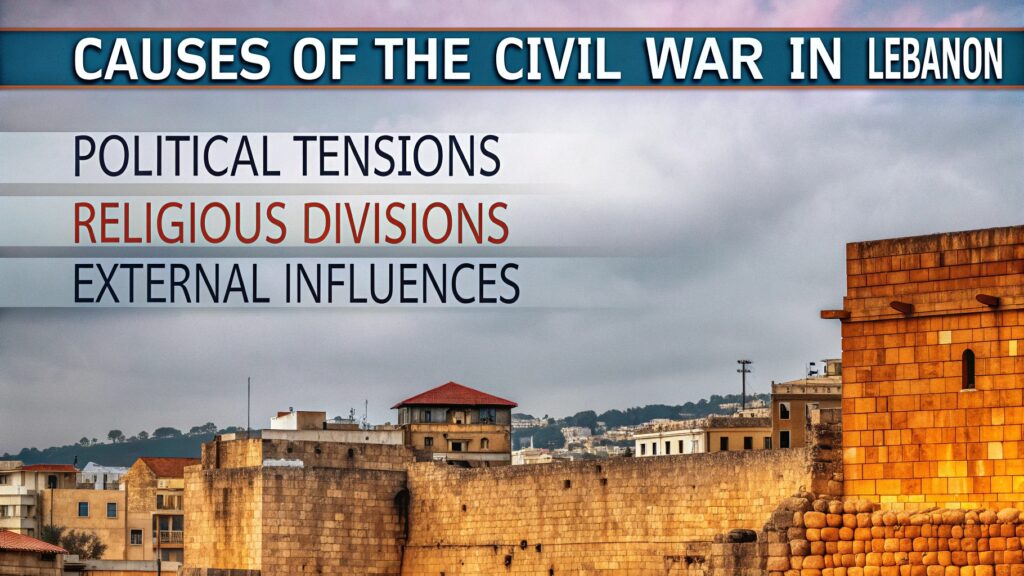
The causes of the civil war in Lebanon are complex and stem from a mix of political, religious, and social tensions that built up over decades. Understanding these causes is essential to grasp why Lebanon’s conflict erupted in 1975 and lasted for 15 years.
🌍 Historical Background and Early Causes of the Civil War in Lebanon
Lebanon has always been a mosaic of diverse religious and ethnic communities, including Maronite Christians, Sunni Muslims, Shia Muslims, Druze, and others. Since its independence in 1943, Lebanon’s political system was based on a delicate confessional power-sharing arrangement. This system divided political power among different religious groups, but it also sowed seeds of resentment and competition.
⚠️ Political Causes of the Civil War in Lebanon
One of the main causes of the Lebanese civil war was the failure of the confessional political system. The imbalance in political representation, especially the underrepresentation of Muslims compared to Christians, caused growing tensions. Additionally, the influx of Palestinian refugees after the 1948 and 1967 Arab-Israeli wars destabilized Lebanon’s fragile demographic balance.
When studying the causes of the civil war in Lebanon, it’s clear that the interplay between political power struggles and sectarian divisions played a major role in igniting the conflict.
The rise of Palestinian militant groups such as the Palestine Liberation Organization (PLO) and their presence in southern Lebanon exacerbated tensions with Lebanese factions and Israel. Lebanese Christians, especially the Maronite militias, feared losing political control and felt threatened by the growing Palestinian armed presence.
✝️ Religious and Sectarian Roots of the Lebanese Civil War
The sectarian divide was a critical factor that fueled mistrust and violence. Lebanon’s religious communities often aligned with different political and foreign powers. For example, Maronite Christians generally supported Western countries and had close ties with France and the US, while many Muslim groups looked towards Arab nationalist movements and Syria.
This sectarian fragmentation led to the formation of militias along religious lines, turning Lebanon into a battleground of competing sectarian interests.
🌐 Regional Powers and the Causes of the Civil War in Lebanon
Lebanon’s civil war was not just a local conflict; it was influenced by regional and international powers. Syria, Israel, Iran, the United States, and other countries played strategic roles by supporting various Lebanese factions.
- Syria initially intervened militarily to assert its influence and protect its interests.
- Israel invaded Lebanon in 1982 aiming to expel the PLO.
- Iran supported emerging Shia groups like Hezbollah.
These interventions further complicated and prolonged the conflict.
💥 Trigger Events That Led to the Lebanese Civil War
The trigger event was the 1975 bus attack in Beirut, where a bus carrying Palestinians was ambushed, killing several passengers. This attack ignited the already simmering tensions into a full-scale civil war.
🔚 Long-Term Effects and Lessons from the Civil War in Lebanon
The Lebanese civil war resulted in over 120,000 deaths, massive displacement, and widespread destruction. It ended with the Taif Agreement in 1989, which restructured Lebanon’s political system but left many underlying issues unresolved.
Understanding the causes of the civil war in Lebanon helps explain Lebanon’s current political challenges and sectarian tensions. Despite the war’s devastation, Lebanon remains a symbol of coexistence and resilience.