The Fall of Phoenician Cities to Alexander the Great: Historical Background
The fall of Phoenician cities to Alexander the Great marks one of the most dramatic turning points in ancient Mediterranean history. In 332 BCE, the powerful coastal cities of Phoenicia — located in present-day Lebanon — faced the unstoppable advance of Alexander the Great during his campaign against the Persian Empire. At that moment, these cities, once masters of trade and naval power, were forced to choose between surrender and destruction.
Although Phoenicia had flourished for centuries, the arrival of Alexander changed its destiny. Consequently, the eastern Mediterranean entered a new political and cultural era that would shape the region for generations.
Phoenicia Before the Fall of Phoenician Cities to Alexander the Great
Before Alexander’s campaign, Phoenicia was not a unified kingdom. Instead, it consisted of independent city-states such as Tyre, Sidon, Byblos, and Arwad. Each city controlled its own territory, fleet, and trade networks.
For centuries, these cities dominated Mediterranean commerce. In fact, they founded colonies as far as Carthage in North Africa. Through trade, shipbuilding, and navigation, Phoenicia became one of the most influential maritime civilizations of the ancient world.
However, by the 4th century BCE, Phoenicia had fallen under the authority of the Achaemenid Empire. While the Phoenician cities retained a degree of autonomy, they were required to provide ships and sailors for the Persian navy. Therefore, their prosperity was closely tied to Persian power.
When Alexander defeated the Persians at the Battle of Issus in 333 BCE, the political balance shifted dramatically. As a result, Phoenicia suddenly found itself vulnerable.
Alexander’s Strategy Leading to the Fall of Phoenician Cities
Alexander’s objective was clear. First, he needed to eliminate Persian naval power. Second, he had to secure the eastern Mediterranean coastline before advancing toward Egypt.
Instead of confronting the Persian fleet directly, he adopted a smarter strategy. By capturing Phoenician ports one by one, he would deprive Persia of its naval bases. Consequently, the Persian fleet would collapse without a major sea battle.
This strategy proved effective. After witnessing Persia’s defeat at Issus, many Phoenician cities reconsidered their loyalties.
Peaceful Surrenders Before the Fall of Phoenician Cities
Byblos During the Fall of Phoenician Cities to Alexander
Byblos quickly opened its gates to Alexander. Because it surrendered peacefully, the city avoided destruction. Moreover, it was allowed to maintain a level of local governance under Macedonian oversight. As a result, Byblos continued to thrive culturally and economically.
Sidon and the Fall of Phoenician Cities to Macedonian Rule
Similarly, Sidon chose cooperation over resistance. Nevertheless, Alexander removed the Persian-supported king and appointed a ruler loyal to him. In doing so, he demonstrated both firmness and political intelligence. Although Sidon lost some autonomy, it preserved its infrastructure and population.
Thus, surrender brought stability, whereas resistance would bring devastation.
The Defiance of Tyre
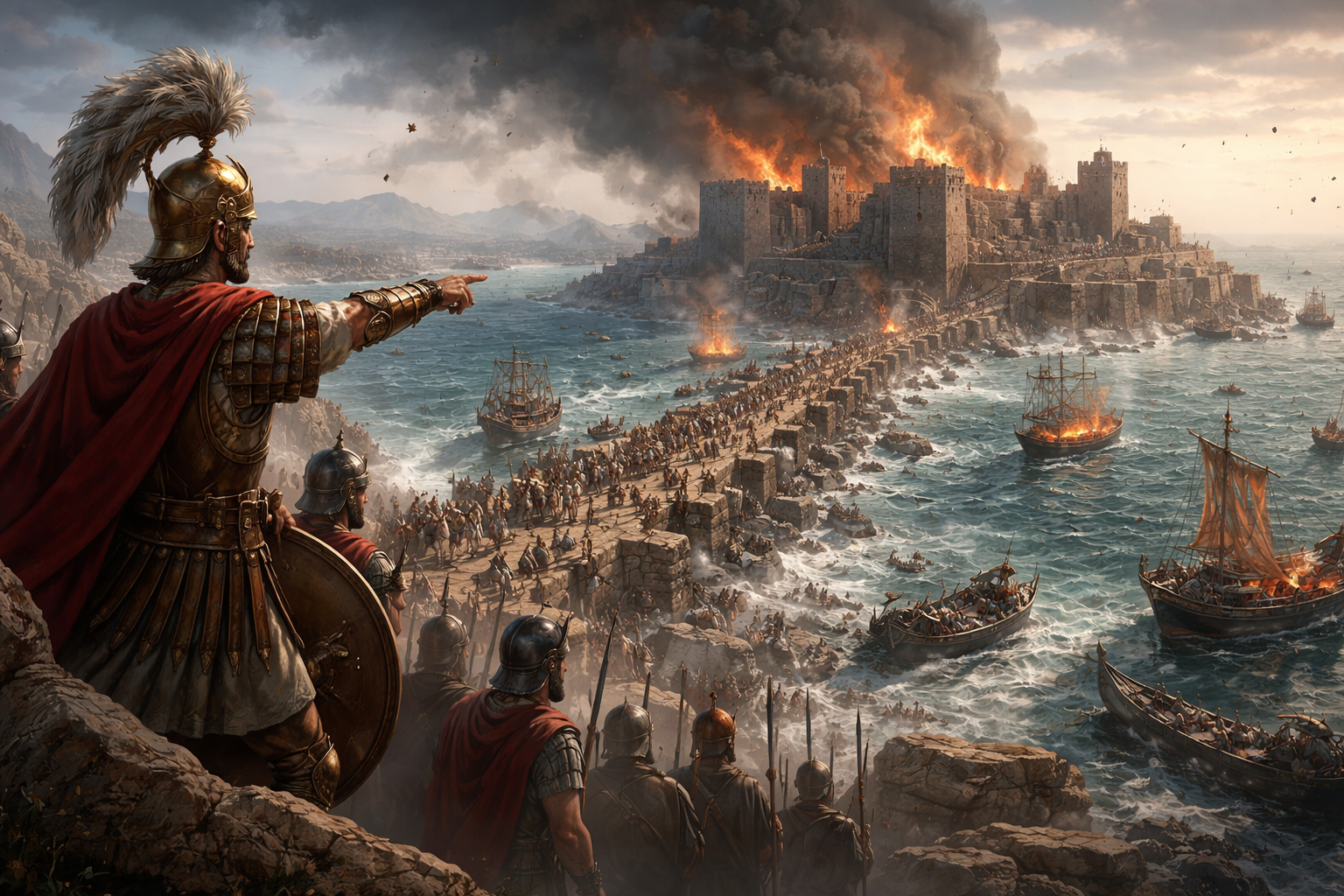
Unlike its neighbors, Tyre refused to submit. At the time, Tyre consisted of a mainland settlement and a fortified island city located about 800 meters offshore. Because of its position and massive defensive walls, the island was considered nearly impregnable.
Alexander requested entry to perform a religious sacrifice to Melqart, whom the Greeks identified with Heracles. However, the Tyrians denied him access, fearing occupation. Consequently, negotiations collapsed, and a siege began in 332 BCE.
The Causeway That Sealed the Fall of Phoenician Cities
Initially, Alexander lacked sufficient naval power to attack the island directly. Therefore, he ordered the construction of a massive causeway from the mainland to the island. Using rubble, timber, and stone, his engineers gradually pushed the structure into the sea.
Meanwhile, the Tyrians fiercely resisted. They launched fire ships, attacked workers, and destroyed siege towers. Nevertheless, Alexander adapted quickly. After securing ships from other Phoenician cities that had surrendered, he imposed a naval blockade.
Eventually, after seven months of relentless pressure, Macedonian forces breached the walls.
The Destruction of Tyre and the Final Fall of Phoenician Cities
When Tyre finally fell, the consequences were severe. Thousands were killed in battle, while many others were enslaved. Although ancient figures may be exaggerated, the devastation was undeniable.
Furthermore, the destruction of Tyre served as a warning to other cities. Resistance would not be tolerated. As a result, remaining coastal centers quickly submitted.
Interestingly, the causeway Alexander built permanently altered Tyre’s geography. Over time, sediment accumulated around it, transforming the former island into a peninsula — a change still visible today.
Arwad and the Collapse of Persian Naval Power
After Tyre’s fall, Arwad and other ports surrendered without major conflict. Consequently, Persian naval dominance in the Mediterranean collapsed. Without Phoenician ships, the Persian fleet could no longer operate effectively.
Thus, Alexander secured complete control of the Levantine coast. From there, he advanced toward Egypt with little resistance.
Phoenicia Under Hellenistic Rule
After Alexander’s death in 323 BCE, his empire fragmented. Eventually, Phoenicia became part of the Seleucid Kingdom under Seleucus I Nicator.
Although political control shifted, Phoenician identity did not disappear immediately. Instead, local traditions blended with Greek culture. Greek became widely spoken, and Hellenistic architecture influenced urban development. Nevertheless, religious practices and elements of Phoenician heritage endured.
Therefore, the fall of Phoenician cities did not erase their civilization. Rather, it transformed it.
Long-Term Consequences
The fall of Phoenician cities to Alexander the Great had lasting effects.
First, it ended centuries of Phoenician maritime supremacy.
Second, it destroyed Persian naval influence in the Mediterranean.
Third, it accelerated the spread of Hellenistic culture across the Levant.
Finally, it reshaped trade networks and political structures in the region.
In other words, the conquest of Phoenicia was not merely a military campaign. Instead, it marked the beginning of a profound cultural and political transition.
Conclusion
The fall of Phoenician cities to Alexander the Great stands as one of the most significant chapters in ancient Near Eastern history. While Byblos and Sidon chose survival through surrender, Tyre chose resistance and suffered immense destruction.
Through strategic brilliance, engineering innovation, and psychological warfare, Alexander dismantled the Phoenician maritime system and secured the eastern Mediterranean. Consequently, a new Hellenistic world emerged from the ashes of conquest.
Yet, despite defeat, Phoenicia’s legacy endured. Its cities adapted, evolved, and continued to influence Mediterranean history. Ultimately, their story reminds us that even in moments of collapse, civilizations can transform and leave lasting marks on the world.