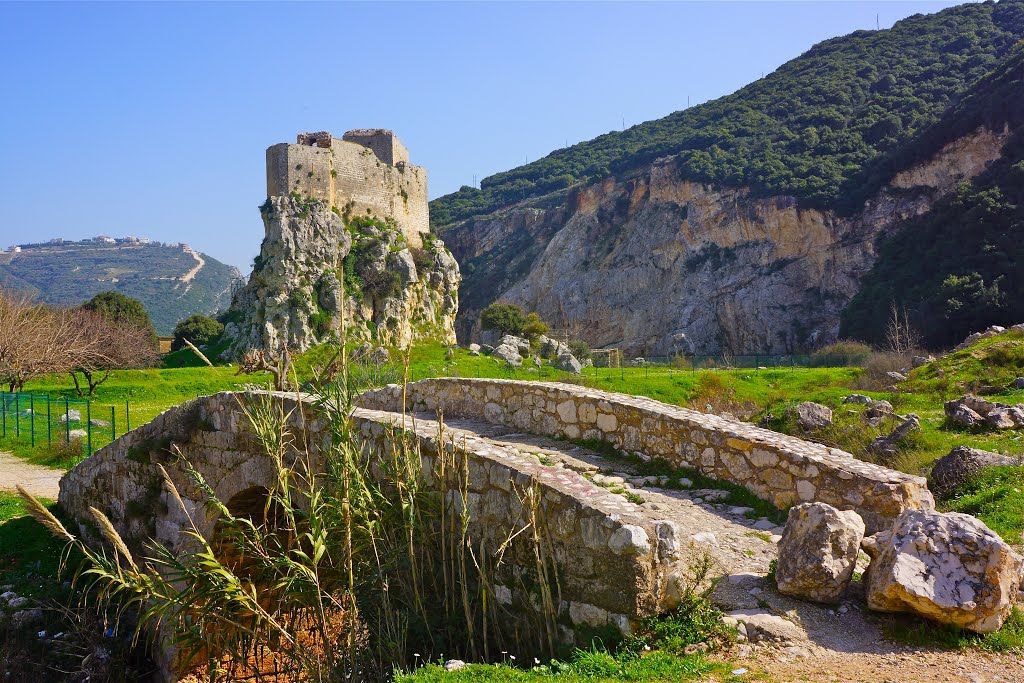
Mseilha Fort Lebanon
Mseilha Fort Lebanon is one of the country’s most fascinating hidden historical sites, rising dramatically above the Nahr el-Jaouz River near Batroun. Perched on a narrow limestone rock, this fortress blends strategic military history with stunning natural scenery, making it a must-visit landmark for culture and heritage lovers.
Mseilha Fort Lebanon: Strategic Location Near Batroun
The fort’s location was carefully chosen. It overlooks a key passage that once connected Tripoli to Beirut, making it an ideal military lookout. Moreover, the surrounding cliffs and steep slopes provided natural protection. As a result, the fort could easily monitor movement through the valley below.
Additionally, the nearby Ras ash-Shaq’a coastal promontory made travel difficult in ancient times. Therefore, controlling this inland route was essential. Mseilha Fort served as both a defensive barrier and a warning post against potential invaders.
History of Mseilha Fort Lebanon
Although the site may have been used earlier, the current structure dates back to the early 17th century, around 1624. Most historians attribute its construction to Emir Fakhr al-Din II, one of the most influential rulers in Mount Lebanon’s history. He ordered the fort to strengthen regional defenses during the Ottoman period.
Furthermore, the construction was supervised by Sheikh Abi Nader al-Khazin, a trusted local leader. This confirms that Mseilha Fort is not a Crusader castle, as many assume, but rather an Ottoman-era stronghold built for local control and protection.
Architecture and Design Features
Architecturally, Mseilha Fort is both simple and effective. It was built in two main phases, using sandstone blocks quarried from nearby coastal areas. The walls are remarkably thick, measuring between 1.5 and 2 meters, which increased their resistance to attacks.
Inside the fort, visitors can find a small triangular courtyard, narrow rooms, and vaulted corridors. In addition, traces of older limestone blocks suggest that an earlier structure once existed on the same rock. The only entrance is a steep, narrow path carved into the stone, making access difficult for enemies.
Historical Role and Cultural Importance
Throughout its history, Mseilha Fort functioned primarily as a military lookout and control point. Although it was never the site of a major battle, its presence helped secure the region. Over time, it became a symbol of authority and protection.
Interestingly, the fort was once featured on the 25 Lebanese lira banknote, highlighting its national importance. In recent decades, restoration efforts have helped preserve the structure and make it safer for visitors.
Visiting Mseilha Fort Today
Today, Mseilha Fort attracts history lovers, photographers, and hikers. Thanks to its elevated position, it offers stunning views of the valley and surrounding mountains. Above all, it provides a quiet and authentic glimpse into Lebanon’s layered past.
For travelers seeking hidden gems, Mseilha Fort is an unforgettable stop near Batroun.